


No. 40 - Early Departures
Years ago I had a debate with an acquaintance who insisted he would never read a work of fiction because it is not true, and therefore by definition, it is a lie. But although characters and events may be made up, fiction can still help us see the truth in a way that whole volumes of facts and statistics cannot. A history book can accurately tell us what happened when and where, but it cannot take you there and make you feel it, unless your powers of imagination are truly extraordinary. Living history museums like Beamish and the Black Country Museum thrive, because while a traditional museum may display genuine artefacts to help us imagine the past, labelled items behind panes of glass can only do that to a very limited extent.

Fiction has the power to do it. The novels I have written so far can doubtless be criticised on many levels, but my research into period detail has been meticulous. There are sure to be mistakes, but to keep them to a minimum, I have taken any opportunity to help me understand better, the everyday experience of ordinary people between the wars. Indeed, I've come to love the research as much as the writing.
In any age, transport of one sort or another is important to every single person alive, and for that reason, the 'heritage' vehicles that survive are the closest to time machines we're ever likely to have (along with old pubs). Railways have always captured the imagination, featuring in many books and films over the years, and they will no doubt continue to do so. I would argue that you cannot write about a train journey if you've never seen, heard and smelled a train. Photographs can help, but seeing a steam locomotive in action is even better.
"A train doesn't just take us to a place; it takes us to a time." - Bill Bryson
Trains Never Leave
I came upon the drama by accident. My very good friend Dave asked me whether I’d like to get up at some godforsaken time on a Saturday morning to go and watch Tornado, a steam locomotive, leave King’s Cross Station. Or should I say 'depart'? Trains never leave, they always depart. Steam trains were an enthusiasm of his rather than mine, and I think he anticipated an instant and emphatic rejection, particularly given the anti-social hour, which happened to be 6.30 am. I was still working then, but I surprised him by agreeing. Crawling out of bed at 5 am on a weekend may have seemed an act of insanity, but it really was worth it.

Tornado is an A1 Peppercorn Class locomotive which has only been running since 2008, having been built from scratch by enthusiasts. It offered me an unique opportunity to experience an old style steam locomotive as it would have appeared when it was new, because it actually was relatively new.
Every few months, an excursion consisting of vintage rolling stock pulled either by a steam locomotive or a historic diesel engine, leaves a London terminus, often too close to the crack of dawn for comfort. The old carriages are largely restaurant cars, lending inter-war glamour to the national obsession with the ‘dining experience’. The passengers pay several hundred pounds for the privilege of being carried in this manner to various towns and cities around the country. Naturally, York is a popular destination, given it is the home of the National Railway Museum. I may take one of these trips one day, but for the moment I am content to turn up occasionally and watch, camera in hand like a proper train spotter, because when it comes to steam engines, I can appreciate the allure.
I initially agreed to go and see Tornado because conventional wisdom suggests that it is good to try anything once, but I have found myself readily agreeing to repeat the experience a fair few times since, so maybe I have become an enthusiast. I've watched Oliver Cromwell, Union of South Africa, Flying Scotsman and Tangmere steam away, some of them more than once. But there are limits to my interest.
Everyday London
I love old London buses but I don’t know anything about their engine specifications or how many rivets there are in the bodywork. Travis Elborough’s book on the Routemaster, The Bus We Loved (2005) was an ideal read for me because he concentrated on their social impact rather than their specifications. Similarly, I have read books about London boxers of the past without actually being greatly interested in the sport. My interest is cultural - I am interested in Londoners, particularly those alive in the early to mid 20th Century, and therefore their preoccupations become mine to some extent. Steam locomotives, motor-racing, football, horse-racing and boxing were all part of the everyday fabric of London during the early to mid-20th Century, the period of British history that most interests me. I will never be all that engaged by the science and engineering aspect of the railway, and what I need to know, my more knowledgeable companion is always happy to explain to me.

We were at Paddington one weekend watching the departure of the Union of South Africa, a streamlined Class A4 locomotive. As it stood at the platform smoking and wreathed in steam, I couldn’t help trying to imagine what the enormous station, designed by Isambard Kingdom Brunel, must have been like when there was a locomotive on every platform.
The soot and smoke helped blacken the station and every building in its vicinity and the periodic venting of steam pressure, not to mention steam whistles, must have made conversation quite difficult. Much of David Lean’s 1945 film of Noel Coward’s Brief Encounter is set in a railway station. Had it been more realistic, Trevor Howard and Celia Johnson might have given up on their dalliance a lot sooner. Their subtle flirtation would have struggled, because the clipped accents they used to communicate would have been completely drowned out by the din.

Despite fond recollections of steam, the perceived golden age for the railways, modern trains are faster, more reliable and kinder to the environment. But they cannot begin to compete with the sheer drama of a working steam locomotive - the gigantic iron wheels, the smell of burning coal and the mighty percussion of the train, as it gets underway. What else would persuade a group of British Transport Police constables to momentarily set aside their professional gravitas, to take a ‘selfie’ with the iconic Flying Scotsman?
It can be hard to get out of bed so early, particularly on a Saturday morning, but if you do, you get a really impressive experience, and it is over so early that the whole weekend stretches out before you. Also, I find an almond croissant and a cappuccino can be ample compensation for missing breakfast.
"Every small boy wanted to be a steam engine driver when they grew up, including me. There's something very special about them — the noise, the smell, the steam coming out everywhere." — Henry David Thoreau
Steaming into the Sunset
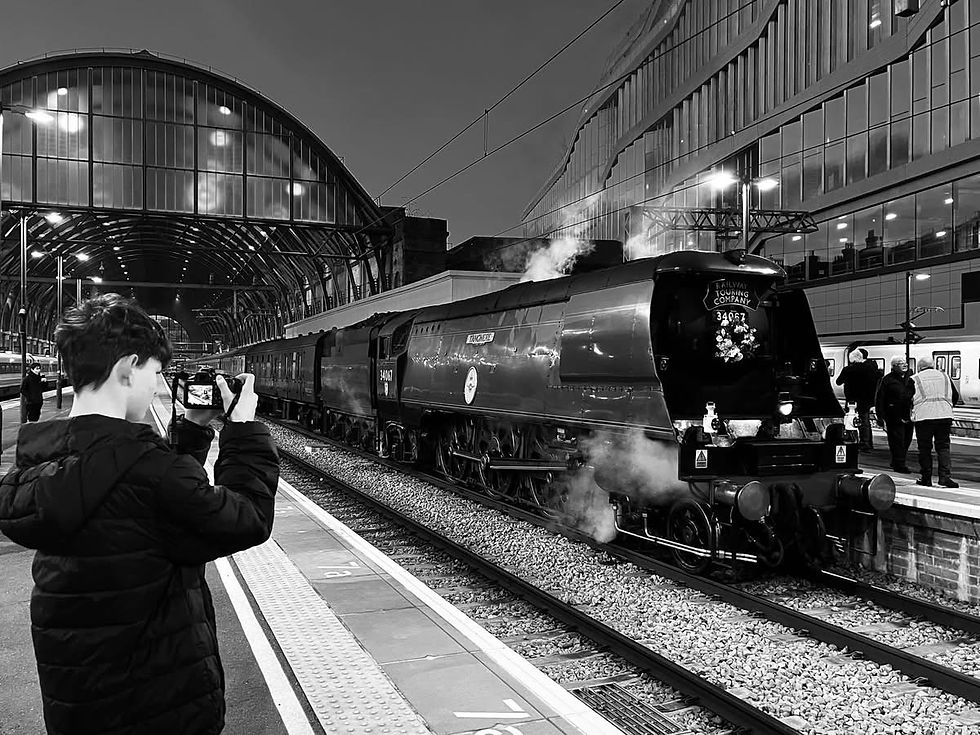
Perhaps its appropriate that my love of the past took me to watch the departure of the Battle of Britain class locomotive Tangmere from Kings Cross on Valentine's Day. Dave was able to tell me that this was a Southern Railways loco which would never have run out of King's Cross, an LNER station. It's the sort of important detail he's good for, which I greatly appreciate.
Many steam enthusiasts are of a certain age and other events we'd attended suggested that interest in these old trains might wane as the generations that remember them gradually die out. That, along with the practical difficulties of running the trains on a main line into London, might lead to the old locomotives departing from the capital for the last time. However it was notable and very encouraging that so many young people had taken the trouble to get out of bed early to see this 79-year-old engine steaming off. These trains have been an attraction since they were at the cutting edge, a symbol of progress, and even though they have become an antique novelty, they retain the magic they've always had. And I hope they last forever.
I am full of admiration for the knowledgeable volunteers who keep these trains running. I feel the same about those who restore old wirelesses, telephones, motor cars and other antique equipment, preserving working pieces of the past for posterity, and giving those who write about it a better chance of getting it right.
"The smoke and the fire and the speed, the action and the sound, and everything that goes together, [the steam engine] is the most beautiful machine that we ever made, there's just nothing like it." — Arthur L. Costa
Film Clips
Tornado filmed standing at King's Cross by Dave Noad (30 sec)
Union of South Africa, steaming across the country, from The Fenman YouTube channel. (2 min)
Train of Events (1949) - features a catastrophic journey out of Euston. (3 min)


Comments